
Logistics & freight
96-hour Shanghai waits: Planning port congestion and blank sailings
A cheap ocean rate is no help when a container waits four days outside the terminal. Plan buffers, alternates and escalation triggers.
 Vinko Kolar· on the ground in Guangzhou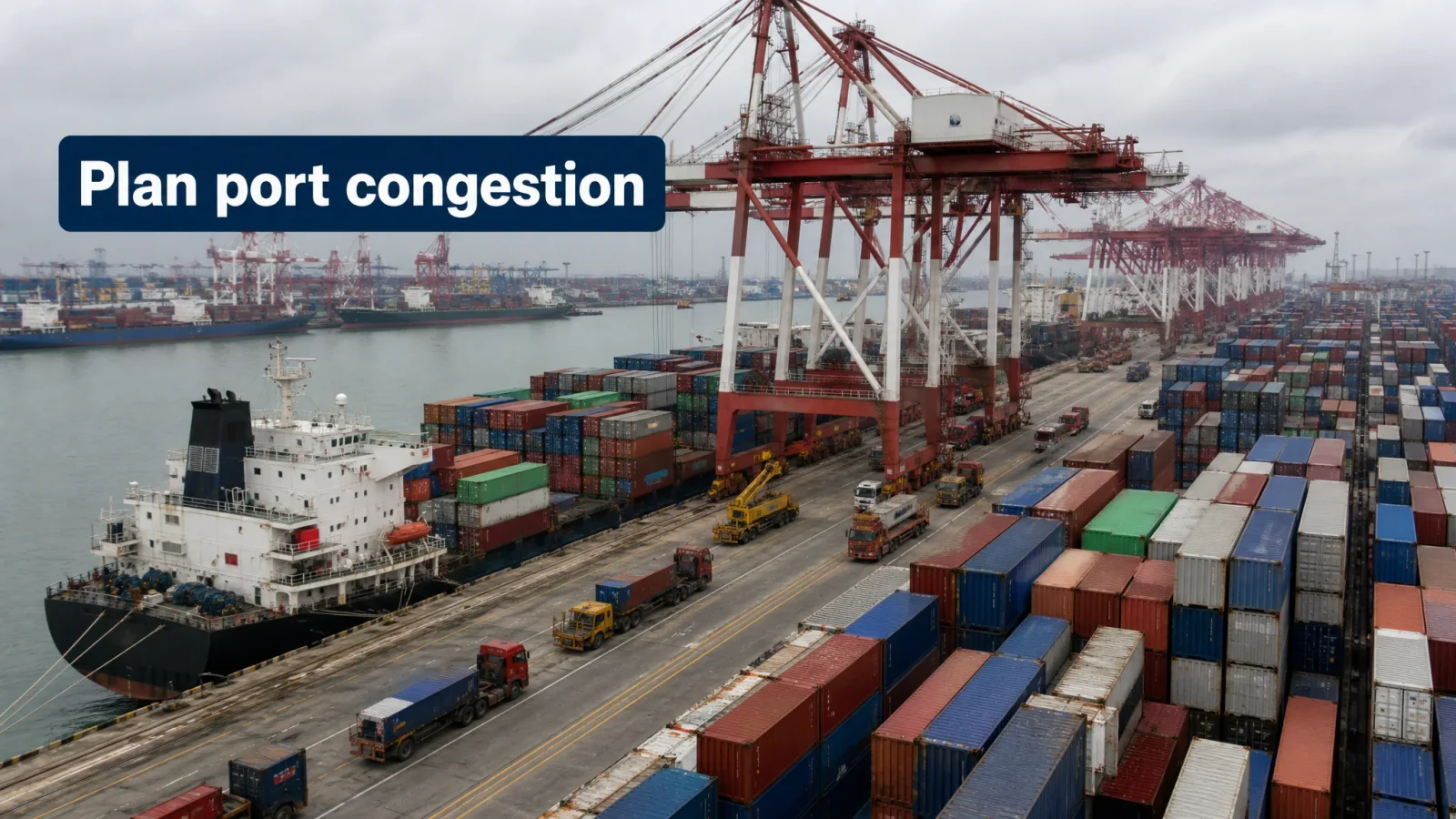
Drewry reported average Shanghai waiting time of 96 hours on 27 August 2026, up from 35 hours the previous week, with four blank sailings announced on Asia–Europe services. For China importers this is a planning issue: a ready container can still miss its booked service.
Price the pre-terminal wait
Separate factory completion, trucking, gate-in, cut-off and actual departure. “Cargo ready” does not mean “on board”.
A blank sailing is a capacity gap
When a service is skipped, departure, connections, equipment, storage and customer promises can all move at once.
Define alternatives in advance
Ningbo, Yantian or a later sailing are not automatic fixes. Check pre-carriage, cost, transit and whether the supplier can divert the box.
Practical checklist
- Put a port and departure buffer into the production plan.
- Confirm carrier status, cut-off and equipment in writing 48–72 hours before gate-in.
- Prepare an alternate route and an approval threshold for critical orders.
- Communicate customer ETA after confirmed gate-in, not only after booking.
Decision frame for your import
Drewry reported average vessel waiting time at Shanghai of 96 hours on 27 August 2026, versus 35 hours the previous week. It also counted four blank sailings on Asia–Europe services for the following week. This is an operational warning: a booked container is not a guaranteed departure and an ETA needs a buffer.
Data and document pack per item
For each order track cargo-ready date, gate-in cut-off, VGM deadline, booking number, terminal, planned departure, live ETA, free days and escalation contact. Separate factory completion, drayage, gate-in, loading and actual sailing. This identifies whether a delay sits at the plant, terminal or carrier.
- Request daily status from cargo-ready to actual sailing.
- Prepare at least one alternate sailing and port.
- Plan seasonal and campaign stock with a buffer instead of average ETA.
- Expose demurrage, storage and customer-impact cost for a delay.
A verification workflow from supplier to import
- Confirm cut-offs and terminal in writing at booking.
- Before cargo-ready, check that production can meet VGM and gate-in deadlines.
- Escalate jointly to forwarder and factory after a material status variance.
- After a blank sailing, model a new sailing, diversion or partial shipment immediately.
- Feed root cause, waiting time and cost into the carrier scorecard.
A worked decision example
A container is ready on 1 September, but gate-in closes on 2 September and the planned sailing is cancelled. Without a backup booking, delivery moves a week. With a reserved second sailing and a ten-day stock buffer, customer delivery remains stable even with a modest freight premium.
Common failure modes and countermeasures
- Treating booking ETA as fixed — wait for actual departure.
- Confusing factory completion with gate-in — record both.
- Discovering blank sailings on departure day — check status daily.
- Buffering only ocean transit — include drayage, terminal and customs.
Message to send to the Chinese supplier
The supplier must report readiness data consistently:
Please confirm production completion, packed dimensions, VGM readiness and earliest gate-in date. Please report delays at least 48 hours before the agreed cargo-ready date. Please keep PO, booking, container and seal references identical in every update.
Release criteria for the file
A release is defensible only when four questions can be answered from the same record: What exactly was checked? Which SKU, batch, route or period does the statement cover? Which primary source or supplier document supports it? Who assessed the deviation and when is it reviewed again? Put those answers in the inspection report instead of marking a line only “passed”. Link the file to the order, sample and receipt. If evidence is missing, give the line an “open” status with an owner and due date. This keeps later corrections traceable and lets procurement distinguish evidence from assumptions.
Follow-up and recheck
Approval is not the end of the check. Set a trigger for the next review: a new batch, material or process change, an authority notice, a price or lead-time deviation, or the scheduled review date. A short monthly reconciliation of orders, supplier data and received goods catches drift earlier than an annual catch-up. When a deviation appears, hold the affected batch, obtain a written supplier response and reopen approval only after a documented corrective record.
<!-- Release template: research review 2026-09 -->Internal release template
A check mark saying “reviewed” is not enough for this topic. In one short line, state that request daily status from cargo-ready to actual sailing.. Add the exact scope (SKU, batch, plant, shipment or period), the primary source and document version. The second line records the open assumption or deviation, its owner and due date. The third line records the release decision and which shipment or version remains on hold. Another colleague should be able to reproduce the decision without searching an entire email thread.
Conclusion
Congestion cannot be negotiated away, but its impact can be bounded. Separating factory, port and customer milestones reveals the critical week earlier.
Frequently asked questions
Should I switch ports immediately at 96 hours?
Not automatically. Compare the whole chain using ETA, cost, equipment and factory location.
What is a blank sailing?
A scheduled departure is omitted. Capacity and timing must then be re-confirmed.
Should every Shanghai shipment expect 96 hours?
No. Drewry’s figure is an average market indicator. Terminal, carrier, vessel and week can differ; use it as a risk signal.
When is an alternate port worthwhile?
When extra drayage and handling cost less than a missed sailing, customer stoppage or demurrage.
Sources
Reading aid
Glossary terms in this article
These terms occur in the article. Hover over a highlighted term or open its entry for the full explanation.
- Blank sailing
- A blank sailing is the cancellation of a scheduled vessel departure or port call.
- Demurrage
- Demurrage is a terminal charge when a container stays beyond its free time.
- VGM
- VGM (Verified Gross Mass) is the verified gross mass of a packed export container.
Editorial source review: Drewry’s 96-hour and four-blank-sailing figures were converted into an operational port and ETA plan; no own port observation is claimed.
FAQ
Should I switch ports immediately at 96 hours?
Not automatically. Compare the whole chain using ETA, cost, equipment and factory location.
What is a blank sailing?
A scheduled departure is omitted. Capacity and timing must then be re-confirmed.
Should every Shanghai shipment expect 96 hours?
No. Drewry’s figure is an average market indicator. Terminal, carrier, vessel and week can differ; use it as a risk signal.
When is an alternate port worthwhile?
When extra drayage and handling cost less than a missed sailing, customer stoppage or demurrage.
Read more
Certified e-commerce merchant (IHK), lives in Guangzhou, inspects Chinese suppliers in person.
About the author →