
Product safety
EU Screens 1,700 Online Listings: 560 Orders over Missing Product-Safety Information
The European Commission and national authorities reviewed almost 1,700 listings on 35 online marketplaces between May and July 2026. Only 58% contained manufacturer information, an EU responsible person and product-identification data at the same time.
 Vinko Kolar· on the ground in Guangzhou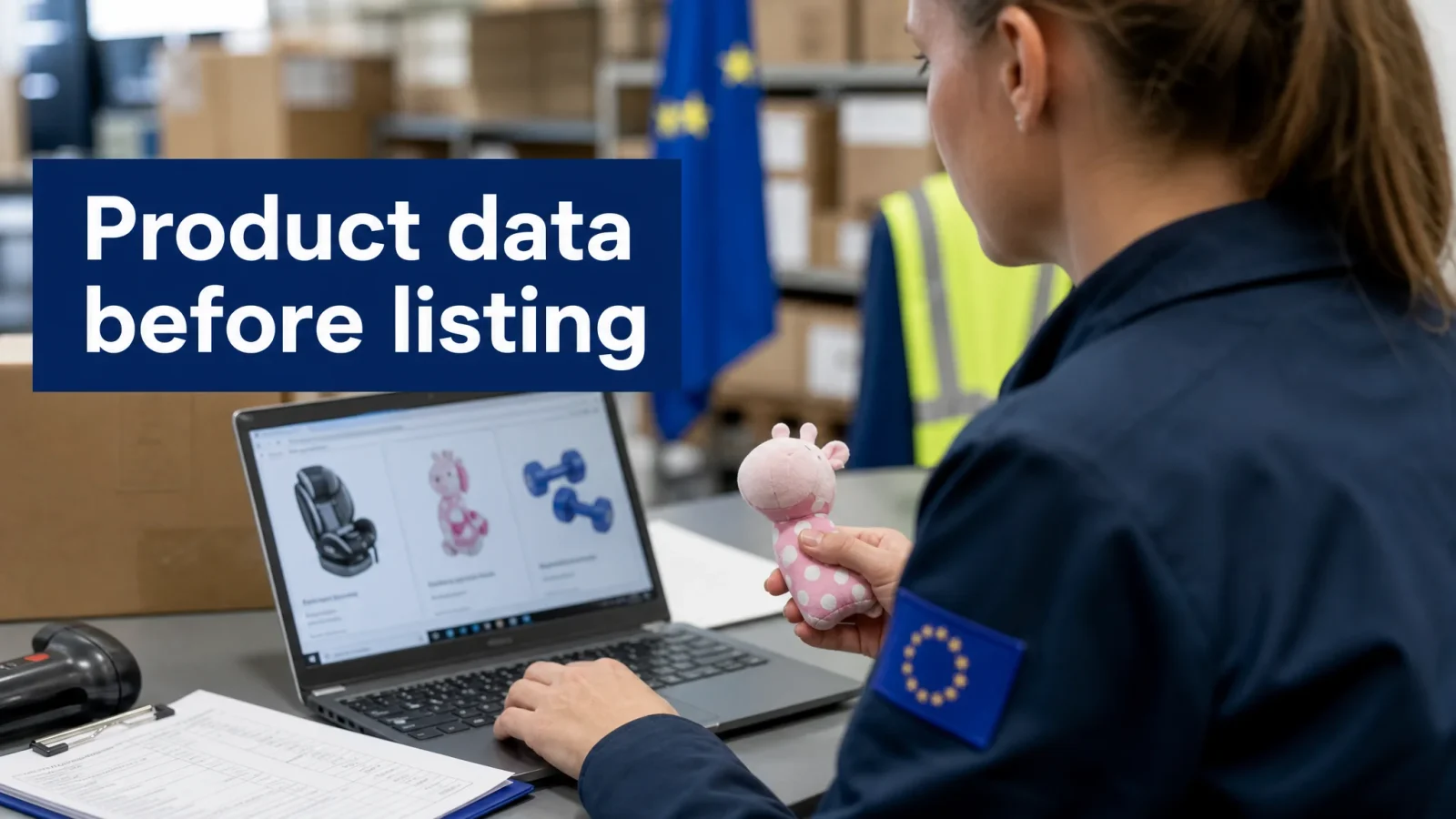
What did the EU publish on 7 September 2026?
The European Commission and national market-surveillance authorities published the results of a product-safety sweep on 7 September 2026. Between May and July 2026, the authorities reviewed almost 1,700 online listings across 35 online marketplaces.
The review covered listings for childcare products and fitness items. In this context, a “sweep” is a coordinated review carried out during a defined period across a set of online listings. The results therefore show how often the specified information and marketplace contact arrangements were present in the reviewed material.
The publication matters to China-based sellers because an online listing is itself part of the visible compliance picture. Many listings did not contain manufacturer information, an EU responsible person and product-identification data at the same time. That gap can create a concrete enforcement risk even though the sweep was not a complete technical safety assessment of every product.
Which figures are firmly supported?
The supported figures cover the size of the review, the information shown in listings, marketplace contact arrangements and the orders issued by authorities. They do not provide a technical safety rating for each individual product.
| Review point | Result | Meaning or comparison |
|---|---|---|
| Online listings reviewed | almost 1,700 | Review conducted between May and July 2026 |
| Online marketplaces reviewed | 35 | Listings were reviewed across these marketplaces |
| Marketplaces registered in the Safety Gate portal | 91% | The previous-year figure was 53% |
| Marketplaces with the prescribed authority contact | 91% | A contact for authorities had been designated |
| Marketplaces with a single consumer contact point | 100% | The previous-year figure was 64% |
| Listings containing all three information groups | 58% | Manufacturer, EU responsible person and product identification together |
| Orders issued by national authorities | 560 | Orders addressed online marketplaces over non-compliant listings |
The 58% figure means that 58% of the reviewed listings contained all three information groups together. It does not mean that the remaining 42% represented technically unsafe products. The supported conclusion is narrower: those listings did not contain all three groups at the same time.
The 560 orders demonstrate a concrete enforcement risk for non-compliant listings. The available facts do not state that every order had the same content or that every affected product was technically dangerous. “Order” should therefore not automatically be read as a blanket sales ban.
What marketplace arrangements were reviewed?
The authorities reviewed information arrangements at marketplace level as well as information in individual listings. 91% of the reviewed marketplaces were registered in the Safety Gate portal and had designated the prescribed contact for authorities.
The Safety Gate portal is described in the supplied research material as the portal in which the reviewed marketplaces were registered and through which a contact for authorities was designated. This article does not infer additional portal functions or legal effects beyond that documented point.
All reviewed marketplaces had designated a single contact point for consumers. That figure was 64% in the previous year. The figure for registration and the prescribed authority contact was 53% in the previous year and reached 91% in the 2026 review.
Better marketplace-level arrangements do not automatically correct incomplete individual listings. A marketplace can have an authority contact and a consumer contact point while a particular seller page still lacks manufacturer or product data. Importers therefore need to review each relevant listing rather than relying on the platform’s organisational setup.
Which information was missing from many listings?
The main information gap concerned the simultaneous presence of three groups: manufacturer information, the responsible person in the EU and product-identification data. Only 58% of the reviewed listings contained all three groups together.
Manufacturer information identifies the manufacturer of the product in the listing. An EU responsible person is a person or entity in the European Union shown in the listing as the relevant responsible contact described in the research material. Product-identification data distinguishes the specific product from other products or variants.
These definitions explain the information groups named in the sweep. The supplied facts do not specify one universal wording, one document or one individual data field that applies to every product. Sellers should therefore avoid treating a single generic template as sufficient for every product unless the product-specific requirements have been checked.
For a China-based supplier or seller, a product page containing only a model name may be incomplete for the purposes of this review. A product image does not automatically replace clearly identifiable manufacturer and product data. The practical response is to collect the information in a structured way and match it to the exact listing before publication.
What does the sweep mean for China sellers?
The sweep shows that missing listing information is a distinct enforcement risk. That risk can exist even when the supplier has manufactured the physical product as specified.
China sellers should include listing-information checks in their import and sales-release process. A supplier may provide manufacturer details, model information and other product data, but that does not automatically prove that the published listing is complete. The supplied facts do not define the allocation of individual legal responsibilities between seller, importer and supplier; they do show that authorities issued orders over non-compliant online listings.
The findings are especially relevant to childcare and fitness listings because those categories were included in the review. The facts do not show that only these categories can be affected. They do provide a concrete reason to check the named information groups first in comparable listings.
Do not review only the text stored in an internal catalogue or back-office system. Check the live listing on the marketplace where the product is offered and make sure the information is linked to the exact product and variant. The research material does not specify where on the page each item must appear, but it does show that the simultaneous presence of the three information groups was part of the review.
Which steps should importers take now?
A documented pre-publication listing review can reduce the risk created by missing information. The following checklist is limited to the three information groups named in the sweep and to their assignment to the actual listing.
- Record the manufacturer. Document which manufacturer belongs to the specific product and how that manufacturer is identified in the online listing.
- Check the EU responsible person. Confirm that the responsible person shown in the listing can be clearly linked to the product concerned.
- Assign product-identification data. Use a consistent link between the product, its model, its variant or another available identifier without adding unverified information.
- Compare listing and product. Verify that the data belongs to the product and variant being sold, rather than to a similar model.
- Check live visibility. Open the published product page on the relevant marketplace and confirm that consumers and authorities can find the three information groups.
- Keep a review record. Retain an internal record of the reviewed listing version so changes to manufacturer, responsible-person or identification data can be traced.
- Hold incomplete listings. Delay publication or internal release if one of the three information groups cannot be verified or correctly assigned.
This checklist is not a complete legal or technical product-safety assessment. It is a practical first control based on the information groups identified in the sweep.
What does the sweep not show?
The sweep does not prove that the 42% of listings without all three information groups represented unsafe products. The 42% figure follows only from the fact that 58% contained the three groups at the same time.
The sweep was not a complete technical safety assessment of every product. The supplied facts do not state that every product underwent laboratory testing, a complete design review or an individual risk assessment.
The sweep also does not prove that 560 individual products were banned. The supported fact is that national authorities issued 560 orders to online marketplaces over non-compliant listings. The available research does not describe the type, duration or specific consequence of each order.
The results do not identify which individual marketplace or country of origin was most frequently affected. The data names 35 marketplaces but gives no breakdown by platform, seller, product or country.
Why do the marketplace figures still matter?
The marketplace figures show that organisational compliance and listing compliance can develop at different speeds. 91% of the marketplaces had the specified authority contact, 100% had a single consumer contact point, yet only 58% of listings contained all three information groups.
Compliance here means meeting the requirements examined in the review. The figures are not contradictory: a marketplace may have established its contact structure while individual seller listings remain incomplete. For China sellers, a well-organised platform is therefore not an automatic clearance for every product page.
The increase from 53% to 91% for Safety Gate registration and the prescribed authority contact is supported as a year-on-year comparison. The increase from 64% to 100% for the single consumer contact point is also supported. These comparisons do not establish a trend for all marketplaces or all product categories.
What should importers document with Chinese suppliers?
Importers should clarify the required product information with the supplier before placing an order. The supplied facts do not identify the sourcing location of individual listings, but they show why missing manufacturer and product information can become a problem when the product is offered online.
Request product-specific data rather than relying only on a general catalogue. Link the information to the model and the precise variant. Then verify independently that the data appears in the marketplace listing where the product is actually sold.
An invoice, an internal supplier spreadsheet or an unpublished document does not automatically replace visible information in the listing. That point follows from the sweep’s focus on online listings. The available facts do not provide a complete statement on which additional documents authorities may accept in an individual case.
Evidence, interpretation and open questions
The documented facts are straightforward: the EU and national authorities reviewed almost 1,700 listings on 35 marketplaces, and national authorities issued 560 orders over non-compliant listings. The cautious interpretation is that incomplete product information creates a concrete review and enforcement risk for China sellers.
Open questions remain about the exact fields missing from each listing within the three information groups. The available facts also do not explain the precise type of each order or which additional criteria authorities applied alongside the named information.
The results were intended to feed into discussions at International Product Safety Week, which runs through 10 September 2026. That statement does not establish that additional measures were adopted during the event. No such information is included in the supplied research material.
The practical conclusion is limited but clear: review the manufacturer, EU responsible person and product identification together on every relevant product page. Treat that review as a documented release step, without turning the sweep’s figures into a technical safety assessment of the individual product.
Sources
This article is based on the European Commission Representation in Greece notice dated 7 September 2026 and reporting by The Brussels Times published on the same day. The application adds the complete source list automatically.
Sources
Research checked on 2026-09-08. The following original sources support the factual claims:
- European Commission Representation in Greece – Σάρωση του 2026 για την ασφάλεια των προϊόντων: η συμμόρφωση με τους κανόνες ασφάλειας των προϊόντων βελτιώνεται, όμως εξακολουθούν να υπάρχουν ορισμένα κενά (2026-09-07): Die offizielle Mitteilung nennt fast 1.700 geprüfte Angebote auf 35 Online-Marktplätzen, die Werte von 91 Prozent, 100 Prozent und 58 Prozent sowie 560 Anordnungen wegen nicht konformer Angebote.
- The Brussels Times – EU spotlights progress in product safety rules, but 42% listings fall short (2026-09-07): Die Berichterstattung bestätigt den Umfang des Sweeps, die GPSR-bezogenen Informationsanforderungen, die Verbesserung bei Safety-Gate-Registrierung und Verbraucher-Kontaktstellen sowie die 560 behördlichen Anordnungen.
Reading aid
Glossary terms in this article
These terms occur in the article. Hover over a highlighted term or open its entry for the full explanation.
- Safety Gate
- Safety Gate is the EU rapid alert system for dangerous non-food products and recalls.
FAQ
What did the 2026 EU sweep review?
National market-surveillance authorities reviewed almost 1,700 online listings across 35 online marketplaces between May and July 2026. The review covered listings for childcare products and fitness items.
Which three information groups were assessed together?
The listings were assessed for manufacturer information, an EU responsible person and product-identification data. Only 58% contained all three groups at the same time.
Does the 42% figure mean that those products were unsafe?
No. The figure follows only from the fact that 58% of listings contained all three information groups together. The sweep was not a complete technical safety assessment and does not prove that the remaining products were technically unsafe.
What do the 560 orders mean?
National authorities issued 560 orders to online marketplaces over non-compliant listings. The supplied facts do not describe the content of each order, so the number should not be treated as proof of a general sales ban for all affected products.
What should China sellers check now?
For each relevant listing, check the manufacturer, the EU responsible person and product-identification data, confirm that each item belongs to the exact product and variant, and verify the information on the live marketplace page before release.
Read more
Certified e-commerce merchant (IHK), lives in Guangzhou, inspects Chinese suppliers in person.
About the author →