
Ocean freight and routing
Maersk and Hapag-Lloyd Route AE19 and AE15 via the Suez Canal Again
On 9 September 2026, Maersk said that the AE19 and AE15 services would run via the Suez Canal instead of around the Cape of Good Hope. The announcement describes a targeted adjustment, not a general return of the east-west network.
 Vinko Kolar· on the ground in Guangzhou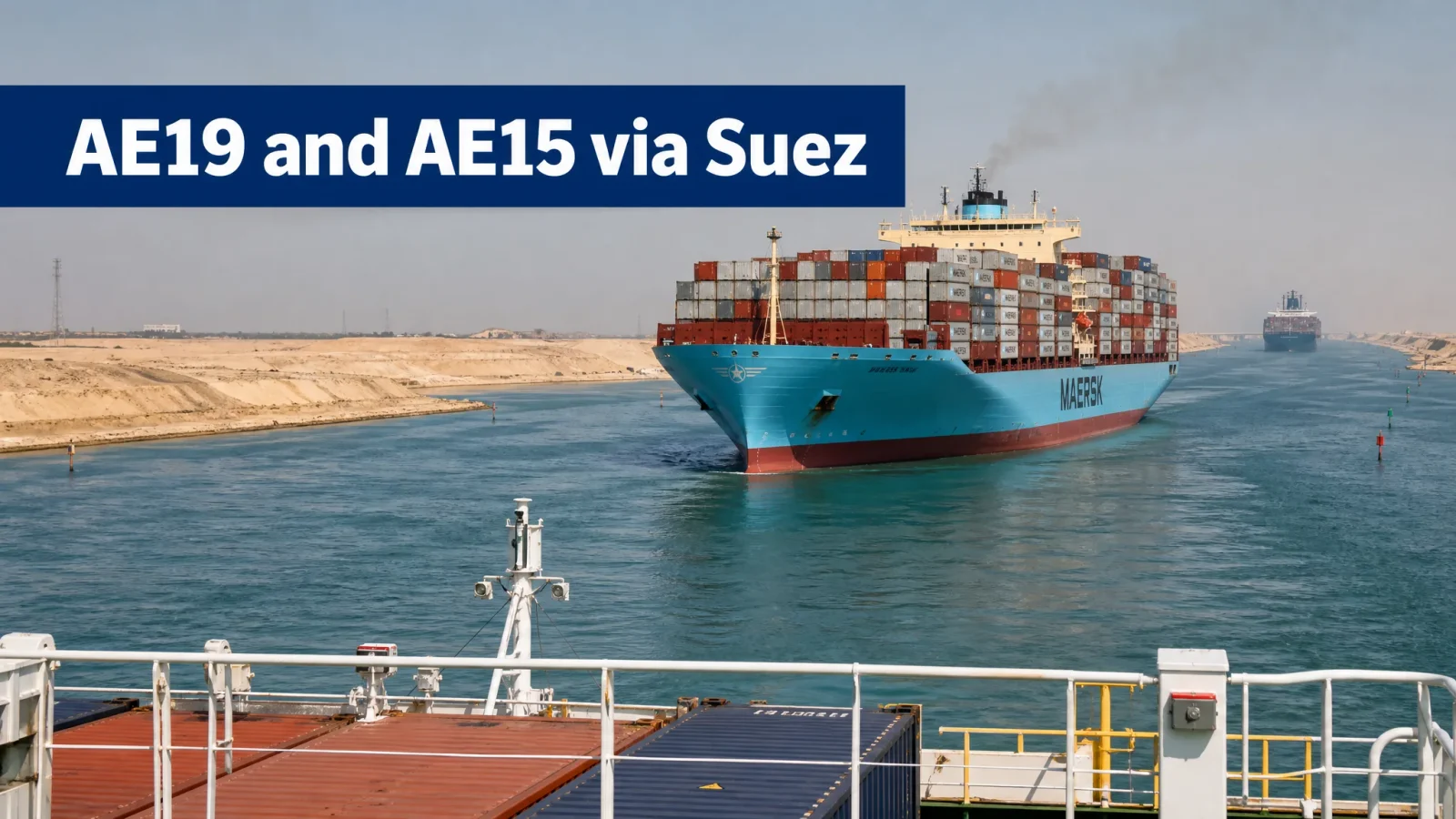
What did Maersk announce on 9 September 2026?
On 9 September 2026, Maersk said that Maersk and Hapag-Lloyd would route the AE19 and AE15 services via the Suez Canal instead of around the Cape of Good Hope. The change therefore applies to two specifically named services and is not described as a network-wide change for east-west services.
A service in this context is a regularly offered liner connection with a defined sailing and port pattern. For an import shipment, it therefore matters not only which carrier accepts the container but also which service appears on the booking confirmation.
Maersk explicitly distinguished the route change from a broad return of the east-west network to the Suez Canal. Importers should therefore not assume that every China-Europe booking will use the Suez Canal simply because AE19 and AE15 have been named.
Which route is changing?
For AE19 and AE15, the route described in the announcement is being shifted from the Cape of Good Hope to the Suez Canal. The information can be organized for booking checks as follows:
| Checkpoint | Previously described routing | Routing announced for the services |
|---|---|---|
| Services | AE19 and AE15 | AE19 and AE15 |
| Routing point | Cape of Good Hope | Suez Canal |
| Nature of change | Previous service routing in the announcement | Targeted adjustment according to Maersk |
| Statement about the rest of the east-west network | Not established by the announcement | No broad return confirmed |
| Importer action | Do not rely on carrier name alone | Confirm service, ETA, route and surcharges |
The table reflects only the route information supplied in the sources. It does not provide a promised transit time, a guaranteed arrival date or evidence that other services will follow the same route.
What does the announcement mean for China-Europe importers?
The announcement is primarily a booking and routing update, not a blanket transit-time forecast. A Suez Canal routing changes the planned sea route of a specific service, but the supplied information does not state a binding port-to-port transit time for any particular shipment.
ETA, or Estimated Time of Arrival, is the expected arrival time or expected arrival date. An ETA is a planning figure rather than an automatic guarantee, especially when weather, port operations or other operational factors affect vessel movements.
Importers should distinguish four separate booking details:
- Service: Is the booking actually on AE19, AE15 or another service?
- ETA: What expected arrival has been confirmed for the specific container or sailing?
- Transit route: Will the shipment use the Suez Canal or sail around the Cape of Good Hope?
- Surcharges: Which additional or changed charges are stated for the specific booking?
These details answer different questions. The service identifies the liner product, the ETA indicates the expected timing, the transit route identifies the intended sea passage, and surcharges concern possible additional costs.
Why should you not assume shorter transit times?
You should not derive a blanket reduction in every China-Europe transit time from the Suez Canal announcement. The supplied information confirms the routing change for AE19 and AE15, but it does not give a general transit-time reduction for all services or guarantee that every booking will operate without deviations.
This distinction affects purchasing and delivery planning. A production deadline, product launch or stock plan should not rely solely on the assumption that a changed route automatically produces a specific arrival date. The current booking confirmation must remain decisive for each shipment.
A transit route is the intended sea passage between the port of departure and the destination port. It is not the same as the ETA. Two bookings may use the same route description while showing different ETAs because they depart at different times or face different operational conditions.
What other disruptions does Maersk report for East Asia?
Maersk reported flooding, port congestion and delays to vessel operations in East Asia during the 2026 typhoon season. These points provide operational context for the route announcement, but they do not replace a status check for an individual booking.
Port congestion means a strain on port operations that can affect vessel handling, container movements or other operational processes. The supplied facts identify congestion as a disruption factor but do not specify a delay duration for any particular port.
Vessel operations are the operational activities connected with handling and operating a vessel. The supplied sources do not provide a detailed cause for every reported delay, so importers should not infer a specific failure or delay mechanism from the general statement.
The practical consequence is clear: a planned Suez Canal route does not automatically remove risks at the origin port or elsewhere in East Asia. Even when the intended sea route is known, flooding, port congestion and vessel-operation delays may affect the ETA and subsequent planning.
What does the reference to 14 ports mean?
In its Asia-Pacific update of 9 September 2026, Maersk said that the share of on-time vessel arrivals had declined in all 14 of the region’s busiest ports. The number 14 refers to the group of busiest regional ports covered by Maersk in that update.
The on-time vessel-arrival rate is the share of vessel arrivals classified as on time under the relevant punctuality measure. The supplied facts state that the rate declined across all 14 ports, but they do not provide a percentage or a single stated threshold for what counts as on time.
The statement should therefore be read as a regional indicator of weaker schedule reliability, not as a specific delay forecast for your container. A reliable shipment plan still requires the current service and sailing status for the individual booking.
How does China’s Golden Week affect planning?
Maersk identifies the first week of October as China’s Golden Week and points to reduced staffing and factory closures. These conditions may disrupt production and logistics processes, so importers should not coordinate collection, documents and bookings solely on the basis of the planned sea route.
In the supplied information, Golden Week refers to a period in the first week of October during which reduced staffing and factory closures may occur. The source does not state that all companies close for the same period and does not provide a general production-loss figure.
This creates several separate checks for an import order:
- The supplier should confirm whether the goods will be ready before the first week of October.
- Shipping arrangements should match the actual availability of the goods.
- The booking should correspond to the confirmed service and sailing.
- The ETA should not be copied into internal deadlines without a renewed review.
- Any possible surcharges should be linked to the specific booking.
These checks do not mean that every factory or port will fully stop during Golden Week. They are a practical review based on Maersk’s warning about reduced staffing and possible factory closures.
How should you verify an AE19 or AE15 booking?
You should turn the route announcement into a documented five-step booking review. The key is to link every answer to the relevant booking rather than relying on a general verbal statement.
A practical importer checklist
- Match the service name: Check whether the booking confirmation actually states AE19 or AE15. A general Maersk or Hapag-Lloyd booking is not sufficient to establish that point.
- Confirm the route in writing: Ask whether the specific shipment is planned to use the Suez Canal instead of the Cape of Good Hope. The route statement should refer to the individual booking.
- Record the ETA: Record the latest confirmed ETA, including its date and its connection to the sailing. Treat the ETA as a planning value, not as a guaranteed delivery date.
- Ask about surcharges: Request all charges that apply or may apply to the booking. The supplied sources confirm neither specific amounts nor a complete list of possible surcharges.
- Add operational risks: Check whether the origin port, cargo or sailing may be affected by the typhoon season, flooding, port congestion, vessel-operation delays or the first week of October.
This checklist separates confirmed booking data from assumptions. It also prevents the word “Suez” from being treated as an automatic guarantee of a particular arrival date or as evidence of a network-wide change.
Which questions should you ask the carrier or forwarder?
You should ask at least five questions in writing before relying on the route in your planning:
- Is the booked service AE19 or AE15?
- Is the Suez Canal the planned transit route for this specific booking?
- Which ETA currently applies to the specific sailing and destination port?
- Which surcharges apply or may apply to the booking?
- Are there indications that the sailing may be affected by the typhoon season, flooding, port congestion, vessel delays or the first week of October?
The sources do not provide standardized answers to these shipment-level questions. That is why the answers should be obtained separately and retained for each booking.
What is confirmed and what remains uncertain?
The confirmed event is Maersk’s announcement on 9 September 2026 that AE19 and AE15 would move from the Cape of Good Hope to the Suez Canal. The sources also confirm that Maersk described the change as targeted, reported disruptions in East Asia, noted a declining on-time-arrival rate across all 14 covered busiest ports and highlighted the first week of October as China’s Golden Week.
The supplied facts do not establish a specific transit time, a specific ETA gain, the amount of individual surcharges, a complete list of affected ports or a general routing decision for other east-west services. These details should therefore not be added or inferred from the announcement.
The phrase “back via the Suez Canal” describes the specifically named routing of AE19 and AE15 in this article. It does not mean that the entire east-west network is again operating via the Suez Canal.
What should importers change in their planning?
The main consequence is a more precise review of each China-Europe booking. You can treat AE19 and AE15 as the specifically named services announced with Suez Canal routing, but you should still confirm the ETA, operational risks and surcharges for every shipment.
Base internal milestones on the latest confirmed ETA and on a documented review of the operational warnings. The supplied sources do not provide an additional universal buffer figure that can be applied to every shipment.
When communicating with suppliers, carriers or forwarders, separate three types of statement:
- Confirmed fact: Maersk announced that AE19 and AE15 would use the Suez Canal instead of the Cape of Good Hope.
- Cautious interpretation: The announcement concerns a targeted adjustment and does not confirm a broad return of the east-west network.
- Open shipment-level question: The exact ETA, possible surcharges and operational deviations must be checked for each booking.
This approach keeps the decision tied to verifiable information. A booking should only be treated as sufficiently documented for planning when the service, transit route, ETA and cost information have been brought together clearly.
Sources
- A.P. Moller - Maersk: “Maersk Europe Market Update September 2026”, 9 September 2026: https://www.maersk.com/news/articles/2026/09/09/europe-market-update-september
- A.P. Moller - Maersk: “Maersk Asia Pacific Market Update – September 2026”, 9 September 2026: https://www.maersk.com/news/articles/2026/09/09/maersk-asia-pacific-market-update-september
Sources
Research checked on 2026-09-10. The following original sources support the factual claims:
- A.P. Moller - Maersk – Maersk Europe Market Update September 2026 (2026-09-09): Maersk bestätigt die Umstellung der Dienste AE19 und AE15 vom Kap der Guten Hoffnung auf den Suezkanal und grenzt sie von einer umfassenden Netzrückkehr ab. (maersk.com)
- A.P. Moller - Maersk – Maersk Asia Pacific Market Update – September 2026 (2026-09-09): Maersk beschreibt die sinkende Pünktlichkeit in allen 14 wichtigsten Häfen der Region sowie die Auswirkungen von Golden Week, Wetter und Hafenkongestion. (maersk.com)
FAQ
Are all China-Europe services now returning to the Suez Canal?
No. Maersk announced a targeted adjustment for AE19 and AE15 and explicitly said that this was not a broad return of the east-west network to the Suez Canal. Other services require separate route confirmation.
Which route is planned for AE19 and AE15?
On 9 September 2026, Maersk said that Maersk and Hapag-Lloyd would route AE19 and AE15 via the Suez Canal instead of around the Cape of Good Hope. You should still request written confirmation for your specific booking.
Will the change automatically shorten delivery times?
No. The supplied information gives no binding transit time and no guaranteed time saving. Check the current ETA for each booking and consider possible disruption from weather, port congestion and vessel operations.
What should importers verify before booking?
Verify the specific service, transit route, ETA and possible surcharges. You should also check cargo readiness and possible effects from the typhoon season and China’s Golden Week.
What does the reference to 14 ports mean?
Maersk reported that the on-time vessel-arrival rate declined in all 14 of the region’s busiest ports covered by its update. The supplied facts do not give a percentage or a specific delay duration for your shipment.
Read more
Certified e-commerce merchant (IHK), lives in Guangzhou, inspects Chinese suppliers in person.
About the author →