
Logistics
Panama Canal Cuts Transit Capacity: What Nine Neopanamax Slots Mean for China–U.S. Shipments
Since September 3, 2026, the Panama Canal has provided nine daily transit slots at the Neopanamax locks. The China–U.S. route is not generally closed, but unconfirmed sailings face greater schedule and availability risk.
 Vinko Kolar· on the ground in Guangzhou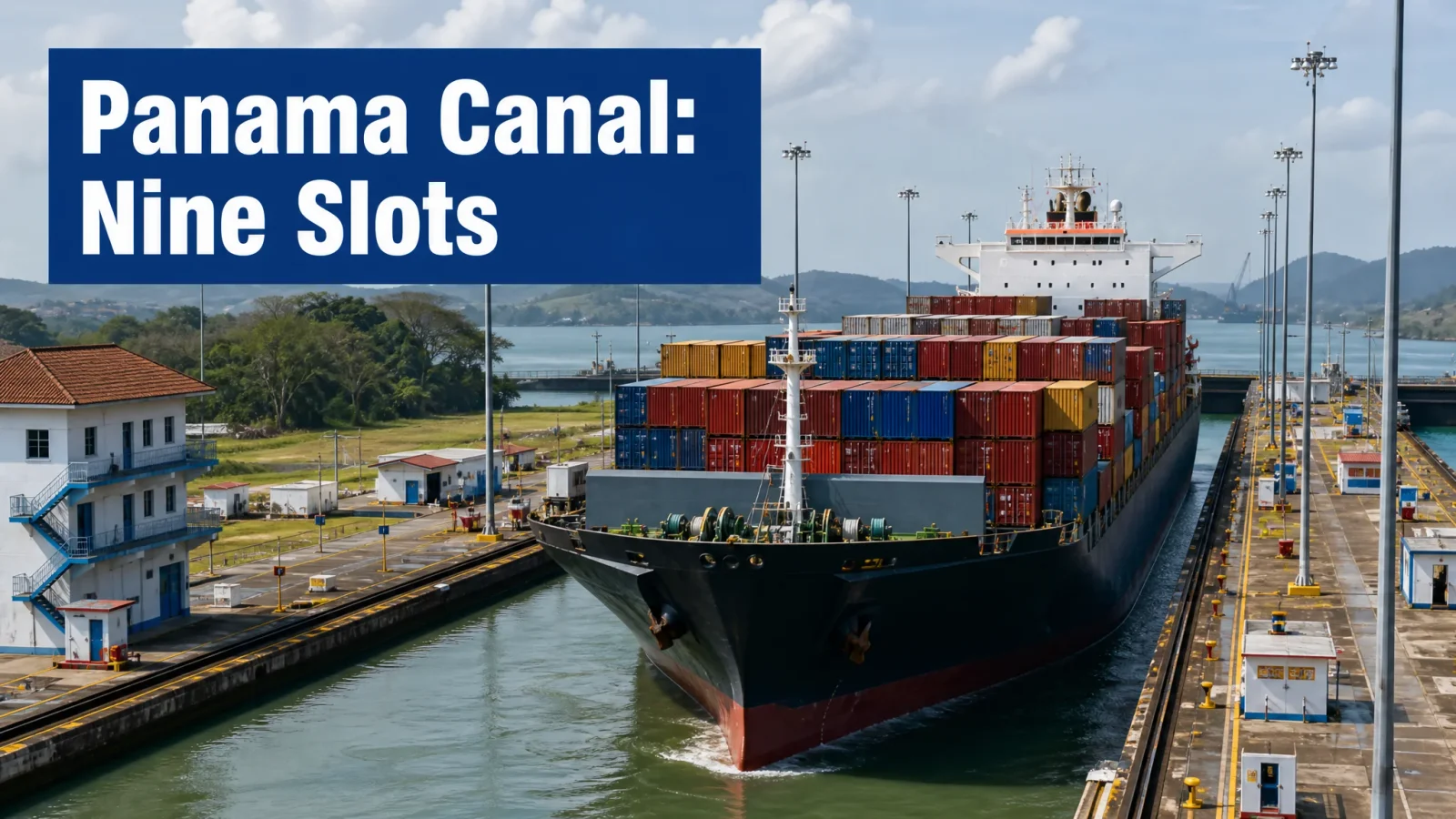
What changed at the Panama Canal on September 3, 2026?
The Neopanamax locks have been limited to nine transit slots per day since September 3, 2026. The Panamax locks are initially scheduled to provide 25 slots per day, falling to 23 from September 15, 2026. This is a reduction in available transit capacity, not evidence of a general closure of the China–U.S. route.
For importers, the immediate issue is the availability of a specific canal transit date. Shipments moving through the canal toward the U.S. East Coast or the U.S. Gulf face a higher risk of tighter slot availability and longer waiting times, particularly when no confirmed canal reservation exists.
The change does not by itself establish a fixed delay for every shipment. The information provided contains no number of additional waiting days, so importers should not build a made-up standard delay into their planning.
What are Neopanamax and Panamax locks?
Neopanamax locks are the larger lock category at the Panama Canal, while Panamax locks serve the smaller Panamax vessel category. The canal publishes separate daily slot figures for the two lock systems.
In this context, Neopanamax is a lock and vessel-category term, not the name of a carrier or a separate China–U.S. trade route. The nine daily Neopanamax slots therefore cannot be treated as the total number of slots available to every vessel. The separate Panamax figures also apply.
A transit slot is an available place for a vessel to make a planned canal transit on a given day. A slot is not automatically the same as a confirmed reservation. According to the Panama Canal, only a confirmed reservation guarantees a specific transit date.
Which slot figures apply?
The relevant figures are nine Neopanamax slots per day, initially 25 Panamax slots per day and 23 Panamax slots per day from September 15. Importers should check the lock category and reservation status separately for each affected shipment.
| Period | Neopanamax locks | Panamax locks | Planning significance |
|---|---|---|---|
| From September 3, 2026 | 9 slots per day | 25 slots per day | Limited transit capacity in both lock categories |
| From September 15, 2026 | 9 slots per day | 23 slots per day | Further reduction in Panamax capacity |
| From October 1, 2026 | 9 slots per day unless otherwise announced | 23 slots per day unless otherwise announced | The planned 14.48-meter draft limit must also be considered |
The table reflects only the supplied planning figures. It does not predict whether a particular vessel will receive a slot or how long a shipment will wait. Those questions depend on the relevant lock category, the reservation status and the operational handling of the voyage.
How are auction slots divided?
Since September 3, 2026, the Panama Canal has divided daily auction slots into four cargo groups. The groups are LNG and LPG; dry bulk and breakbulk; container, vehicle and refrigerated vessels; and tankers.
This arrangement groups auction slots by cargo or vessel category. For container importers, the relevant published category is the combined group for container, vehicle and refrigerated vessels. The supplied information does not state how many slots within that group are allocated to any one vessel type.
The group structure also does not prove that every shipment will be handled through an auction. It describes the Panama Canal’s stated structure for daily auction slots. The applicable reservation process for a particular sailing must be confirmed with the carrier or logistics provider.
What does the change mean for China–U.S. shipments?
The slot reduction increases execution risk for China–U.S. shipments moving toward the U.S. East Coast or the Gulf. It does not establish a general suspension of the China–U.S. route.
The practical planning question is no longer only the expected sailing or arrival date. Importers must also ask whether the vessel has a confirmed canal reservation and what transit date that reservation covers. A shipment may be booked or shown in a schedule without having a guaranteed canal transit date.
The Panama Canal’s stated rule makes the distinction clear: only a confirmed reservation guarantees a specific transit date. An unconfirmed schedule should therefore be treated as a planning estimate rather than a guaranteed milestone.
The impact will differ between shipments. A sailing with a confirmed reservation has a different planning basis from one that is merely listed in a schedule. The provided facts do not quantify that difference in days, so no universal delay estimate should be used.
Why does the 14.48-meter draft limit matter?
The planned maximum Neopanamax draft limit of 14.48 meters was postponed from September 3 to October 1, 2026. The additional measure therefore was not scheduled to begin on the original September 3 date.
Draft is the vertical distance between a vessel’s waterline and its deepest point. A draft limit can be relevant to vessel and loading planning because it may affect how the vessel’s permitted dimensions and cargo load are assessed. The supplied facts do not establish the exact effect of the limit on every vessel or shipment.
The postponement is therefore a change in timing, not evidence that the planned limit has been abandoned. For a Neopanamax voyage scheduled to transit on or after October 1, importers should ask the carrier or logistics provider how the 14.48-meter limit has been incorporated into the voyage plan.
Which facts are confirmed and which points remain open?
The confirmed points are the slot figures, the four auction groups, the reservation rule and the postponement of the draft limit. The supplied information does not confirm a general route closure, a fixed waiting time, a carrier-specific allocation or an identical effect on every container shipment.
Confirmed facts
- The Neopanamax locks have nine daily transit slots from September 3, 2026.
- The Panamax locks initially have 25 daily slots.
- The Panamax figure is scheduled to fall to 23 daily slots from September 15, 2026.
- Daily auction slots are divided into four cargo groups.
- Only a confirmed reservation guarantees a specific transit date, according to the Panama Canal.
- The planned maximum Neopanamax draft limit of 14.48 meters was postponed to October 1, 2026.
Cautious interpretation
Fewer available slots can make date planning more difficult. A confirmed reservation provides a firmer basis for planning than an unconfirmed schedule. For shipments to the U.S. East Coast or Gulf, canal transit availability should therefore be checked as a separate milestone alongside production, pre-carriage and destination planning.
Open questions
The supplied facts do not state how long an individual vessel will wait, how slots are distributed among carriers or how many slots each cargo group receives. They also do not provide a standard transit-time change for China–U.S. shipments. These details should not be inferred from the published slot counts.
What should importers do now?
Importers should review each affected shipment for its route, lock category, confirmed reservation and planned transit date. The result should be recorded in writing so that a schedule is not mistaken for a binding canal reservation.
- Identify the route: Confirm whether the shipment is planned to use the Panama Canal toward the U.S. East Coast or Gulf. The capacity measure is particularly relevant when the canal is part of the intended ocean route.
- Confirm the lock category: Ask whether the vessel is planned for the Neopanamax or Panamax locks. The two categories have different published slot figures from September 3 onward.
- Request the reservation status: Ask for confirmation of whether a canal reservation exists and which specific transit date it covers. Do not treat a general booking or schedule as a guaranteed transit.
- Check the dates: Apply the reduction to 23 Panamax slots from September 15, 2026. For Neopanamax planning, use the published figure of nine daily slots unless a later official update changes it.
- Review the draft from October 1: For an affected Neopanamax voyage, ask how the planned 14.48-meter maximum draft limit is being handled from October 1, 2026.
- Reassess delivery commitments: Flag arrival dates that depend on an unconfirmed canal transit as uncertain. Do not insert an unsupported number of delay days.
- Keep written records: Save the carrier’s or logistics provider’s information on the reservation, transit date, lock category and draft treatment.
What should you ask your logistics provider?
You should request four specific data points for every affected booking: lock category, confirmed reservation status, planned transit date and the treatment of the draft limit from October 1, 2026. These data points make the operational uncertainty easier to verify.
A practical request can include the following questions:
- Is the voyage planned for the Neopanamax or Panamax locks?
- Is there a confirmed Panama Canal reservation?
- What specific transit date is confirmed?
- Which slot figure applies to the planned transit: nine Neopanamax slots, 25 Panamax slots or 23 Panamax slots from September 15?
- If the voyage uses the Neopanamax locks, has the 14.48-meter draft limit from October 1 been considered?
- What information will be provided if the vessel cannot transit on the planned date?
These questions do not create a reservation. They separate verifiable booking information from general schedule expectations.
What should you not conclude from this measure?
You should not conclude that the China–U.S. route has been generally closed. The supplied facts show constrained daily canal capacity, not a complete shutdown of the canal for China–U.S. shipments.
You should also not convert the figures nine, 25 or 23 directly into a fixed delay. A slot count describes available capacity; it is not an automatic delay applied to every shipment. Likewise, the four auction groups do not show how many container or refrigerated vessels will transit on a particular day.
Sources
This article is based on the supplied information from the Autoridad del Canal de Panamá and the operational assessment by C.H. Robinson. The application adds the complete source list automatically.
Sources
Research checked on 2026-09-04. The following original sources support the factual claims:
- Autoridad del Canal de Panamá – Panama Canal Adopts Additional Measures to Address Reduced Precipitation in the Canal Watershed (2026-08-20): Bestätigt die Reduzierung auf neun Neopanamax-Slots und 25 Panamax-Slots ab dem 3. September, die weitere Reduzierung auf 23 Panamax-Slots ab dem 15. September, die vier Auktionsgruppen sowie die Verschiebung des Tiefganglimits auf den 1. Oktober.
- C.H. Robinson – Ocean Shipping Freight Market Update (2026-09-03): Ordnet die seit dem 3. September geltenden Slot-Kürzungen und die für den 15. September angekündigte weitere Reduzierung als zusätzliches Ausführungsrisiko für Transpazifik-Sendungen ein.
FAQ
Is the China–U.S. route closed because of the measure?
No. The supplied facts do not show a general closure of the China–U.S. route. They show reduced daily transit capacity and a higher risk of tight availability and waiting times.
How many Neopanamax slots are available from September 3, 2026?
The Neopanamax locks are limited to nine transit slots per day from September 3, 2026.
How does Panamax capacity change?
The Panamax locks initially provide 25 daily slots. The planned figure falls to 23 daily slots from September 15, 2026.
What guarantees a specific transit date?
According to the Panama Canal, only a confirmed reservation guarantees a specific transit date. A general sailing schedule or booking confirmation is not automatically equivalent to that guarantee.
What does the postponed draft limit mean?
The planned maximum Neopanamax draft limit of 14.48 meters was not scheduled to begin on September 3. According to the supplied information, it is to be considered from October 1, 2026.
Read more
Certified e-commerce merchant (IHK), lives in Guangzhou, inspects Chinese suppliers in person.
About the author →