
Ocean Freight and Lead Times
Typhoons Force China Port Omissions: Three September Sailings Drop Shanghai or Ningbo
Maersk reports flooding, port congestion and vessel delays after several typhoons in East Asia. Three September sailings will omit Shanghai, Ningbo or Kaohsiung.
 Vinko Kolar· on the ground in Guangzhou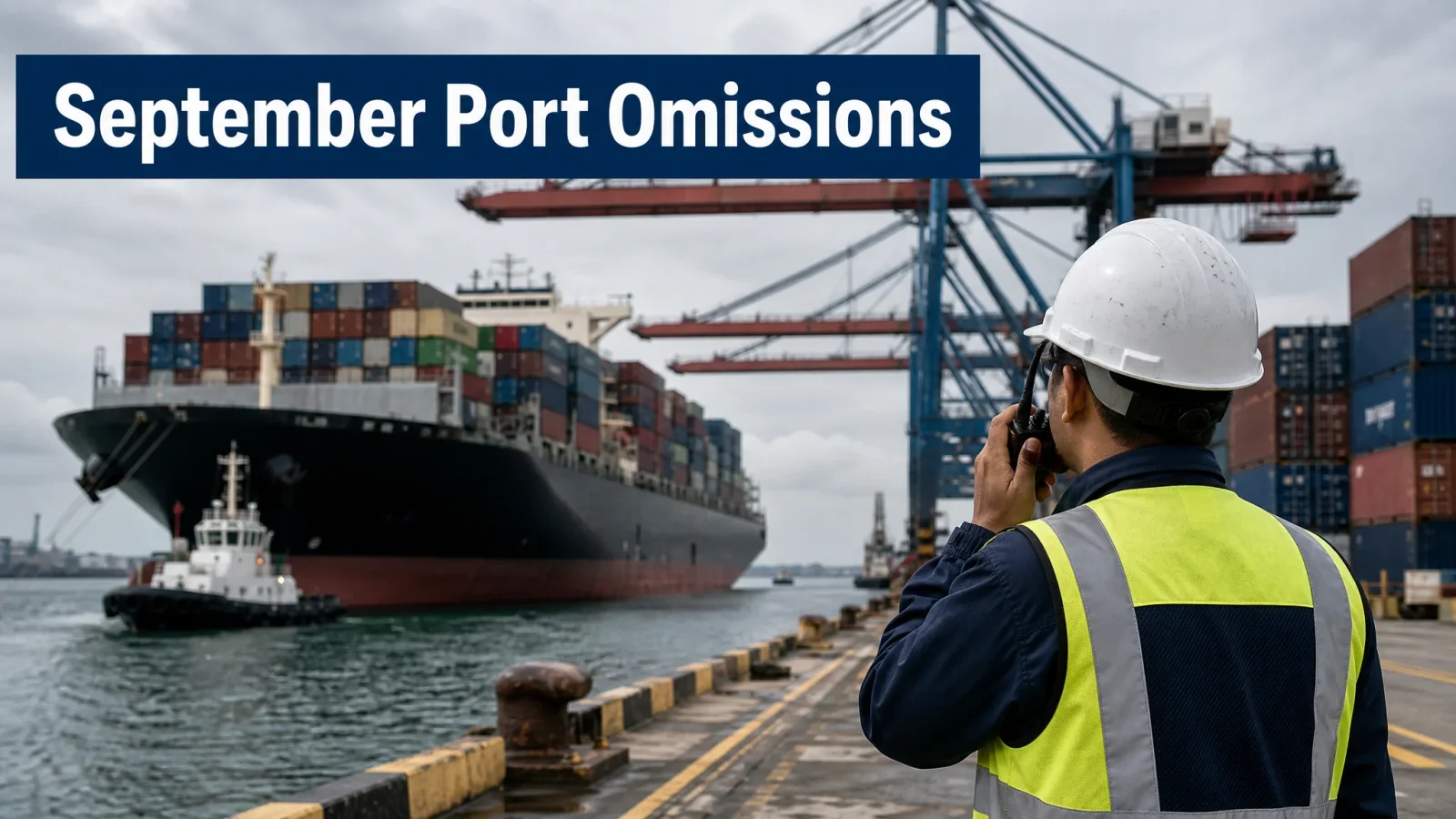
What was confirmed on 5 September 2026?
Three specific port omissions have been confirmed for September 2026 on an Asia-Pacific service. OOCL Busan, SC Montreux and Kota Lestari are scheduled to omit Shanghai, Ningbo or Kaohsiung on specified voyages.
The operational significance lies in the voyage-level change. A voyage is one specific scheduled sailing of a vessel identified by a voyage number. A change at this level initially concerns that sailing and must not automatically be applied to every China-Europe connection or every booking involving the same port.
On 4 September 2026, Maersk reported that several severe typhoons within a two-week period had caused flooding, port congestion and vessel-traffic delays in East Asia. On 5 September, Container News documented the three omissions on China-South Pacific container services and warned of additional cargo backlogs and limited capacity.
Which sailings and ports are affected?
The three confirmed changes involve two omitted ports on OOCL Busan and one omitted port each on SC Montreux and Kota Lestari. The table contains only the changes confirmed in the supplied research material.
| Vessel | Voyage | Omitted port | Period or service |
|---|---|---|---|
| OOCL Busan | 0707S | Shanghai and Kaohsiung | September 2026, Asia-Pacific service |
| SC Montreux | 0478S | Ningbo | September 2026, Asia-Pacific service |
| Kota Lestari | 0286S | Shanghai | September 2026, Asia-Pacific service |
A port omission means that the vessel will not call at the specified port on the named voyage as originally planned. It does not automatically mean that an already booked cargo is cancelled or that it will move through another port without further confirmation.
For OOCL Busan, Shanghai and Kaohsiung are listed as omitted ports. Ningbo is listed for SC Montreux, while Shanghai is listed for Kota Lestari. The supplied information does not specify how each individual booking will be handled after the omission.
Why can typhoons cause schedule changes?
Typhoons can create several linked logistics constraints in East Asia because flooding, port congestion and vessel delays occur at the same time. Maersk described all three effects for the period covered by its notice.
A port omission can be used as a schedule adjustment when a service has been affected by weather-related delays. The available sources confirm the omissions but do not explain the operational reasoning for each individual sailing or the exact sequence of subsequent port calls.
Maersk also referred to Sea-Intelligence data. According to that reference, vessel-arrival punctuality deteriorated at all 14 major ports in the region that were studied. Arrival punctuality is the share of vessel arrivals assessed as being on time under the relevant measurement window. The supplied research does not state the individual punctuality rates or the change in percentage points.
The disruption therefore extends beyond a single port in the available regional data. The confirmed omissions show that carriers are changing schedules at the level of individual voyages. They do not establish that every China-Europe service has been affected by the same changes.
What does this mean for your booking?
The decisive checks for your booking are the vessel, voyage number and planned port. A general typhoon notice cannot replace a carrier, freight forwarder or booking provider confirmation for the specific container.
A move to the next available sailing is a plausible logistics consequence, but it must be confirmed separately for each booking. Maersk stated that new ASIAPAC bookings should be assigned to the earliest available sailing, subject to space.
That statement has two limits. First, it concerns new bookings in the named service and does not automatically confirm the treatment of existing bookings. Second, the allocation depends on available capacity. The notice therefore does not provide a binding new loading date for a specific shipment.
Which checks should you make immediately?
Start by identifying the voyage number and planned loading port. Then compare the current booking status with the carrier’s or freight forwarder’s operational update.
- Identify the voyage: Match your booking to the specific vessel and voyage number.
- Check the port: Confirm whether Shanghai, Ningbo or Kaohsiung is planned as the loading or transshipment port.
- Confirm the omission: Ask for written confirmation of whether your booking is affected.
- Clarify the next sailing: Ask which is the earliest available sailing and whether space is available.
- Record the revised sequence: Keep the confirmed loading information and any available schedule details in the shipment file.
- Review delivery commitments: Reassess internal sales, production or inventory commitments only after receiving an operational update for the shipment.
This checklist separates confirmed information from assumptions. In particular, you should not infer a specific replacement port, guaranteed onward movement or fixed new arrival date from a port omission alone.
What should you consider when making a new booking?
According to the carrier notice, new bookings on the ASIAPAC service should be allocated to the earliest available sailing if space exists. A new booking should therefore be checked against the actually confirmed voyage and available capacity, not only against the requested departure date.
Capacity in this context means the available space or transport availability on a sailing. The source warns of limited capacity and additional cargo backlogs. A cargo backlog occurs when freight cannot move as planned because of earlier disruption and accumulates for later sailings.
Neptune Pacific warned that the additional port omissions would intensify an existing cargo backlog and capacity constraints. This indicates greater uncertainty around allocation, but it does not establish a fixed waiting period for each new booking.
You should keep three pieces of information separate in your records: the requested service, the earliest sailing offered by the carrier and the sailing actually confirmed. These can differ when the requested sailing has insufficient space.
Does this notice affect China-Europe services?
The notice does not automatically affect every China-Europe service. The documented omissions concern specified voyages on an Asia-Pacific service, while the broader information concerns weather effects on East Asian shipping.
A China-Europe connection may operate under a different service, different voyages or different operational instructions. Without a specific carrier notice for the relevant booking, the three omissions do not support a reliable conclusion about a China-Europe shipment.
The transferable lesson is procedural: weather-related disruption can already lead to schedule changes at voyage level. For importers, monitoring the individual booking is therefore more reliable than making a general assessment of the entire trade lane.
Which uncertainties remain?
It remains open how each affected shipment will move after the port omission. The supplied material does not identify one standard replacement port, a binding new departure date or a single new arrival date.
It is also open whether further sailings or ports will be changed after 5 September 2026. Maersk warned that a possible renewed strengthening of Typhoon Saudel and further expected tropical cyclones could prolong the effects.
The statement about possible strengthening is a warning about a scenario, not confirmation of another specific port omission. The available information also does not establish how long restrictions will last at any particular port.
Your planning should therefore keep confirmed facts, plausible consequences and open questions separate. The three voyage changes are confirmed. A shift to a next available sailing is plausible. The individual onward routing, capacity for a particular booking and potential additional changes remain open until separately confirmed.
Which information should you request?
Request an operational update for the specific booking instead of relying only on general news. The update should identify the affected voyage, the port status and the next available option, where known.
Useful information includes:
- current booking status;
- affected vessel and voyage number;
- confirmation of whether the planned port will be omitted;
- possible allocation to the earliest available sailing;
- confirmation of whether space exists on that sailing;
- updated schedule information, where already confirmed;
- points that the carrier cannot yet confirm conclusively.
The supplied sources do not identify new blanket customs, tax or product-safety documentation requirements caused by the typhoon disruption. No general new documentation obligation can therefore be derived from this notice. The Maersk source is described as referring to buffer time, document checks and alternative routing as parts of operational preparation.
What should importers take away?
The three confirmed omissions show that typhoon effects are already producing specific changes to September voyages. The affected sailings are OOCL Busan Voyage 0707S, with Shanghai and Kaohsiung omitted; SC Montreux Voyage 0478S, with Ningbo omitted; and Kota Lestari Voyage 0286S, with Shanghai omitted.
For planning purposes, the relevant combination is the vessel, voyage, service and booking status rather than the port name alone. A next available sailing may be the practical consequence, but it becomes reliable only after separate confirmation.
The report does not establish a general disruption on every China-Europe connection. It does provide a concrete reason to review existing bookings, allow schedule buffers, keep records current and assess alternative options only after confirmation from the responsible carrier or freight forwarder.
Sources
The application will append the complete source list. This article is based on Maersk, “East Asia Typhoon Season Impacts Logistics,” published 4 September 2026, and Container News, “Tropical cyclones disrupt China-South Pacific container services,” published 5 September 2026.
Sources
Research checked on 2026-09-06. The following original sources support the factual claims:
- A.P. Moller - Maersk – East Asia Typhoon Season Impacts Logistics (2026-09-04): Dokumentiert die wetterbedingten Überschwemmungen, Überlastungen und Fahrplanverzögerungen, die Verschlechterung der Pünktlichkeit an 14 großen Häfen sowie die Hinweise zu Pufferzeiten, Dokumentenprüfung und alternativen Routen.
- Container News – Tropical cyclones disrupt China-South Pacific container services (2026-09-05): Dokumentiert die Hafenauslassungen der OOCL Busan, SC Montreux und Kota Lestari sowie den erwarteten zusätzlichen Frachtrückstau und die begrenzte Kapazität.
FAQ
Which three vessels are affected by the confirmed port omissions?
The affected vessels are OOCL Busan on Voyage 0707S, SC Montreux on Voyage 0478S and Kota Lestari on Voyage 0286S. OOCL Busan is reported to omit Shanghai and Kaohsiung, SC Montreux Ningbo and Kota Lestari Shanghai.
Does the notice affect every China-Europe service?
No. The confirmed changes concern specified voyages on an Asia-Pacific service. A China-Europe booking requires separate confirmation from the responsible carrier or freight forwarder.
Will my cargo automatically move to the next sailing?
That is not automatically confirmed. Maersk said that new ASIAPAC bookings should be assigned to the earliest available sailing if space exists. Existing bookings require separate clarification of their onward movement.
What is a port omission?
A port omission means that a vessel will not call at the specified port on the named voyage as originally planned. It does not automatically identify a replacement port or guarantee a new departure date.
What could happen if further typhoons develop?
Maersk warned that a possible renewed strengthening of Typhoon Saudel and further expected tropical cyclones could prolong the effects. Whether a particular booking is affected must be confirmed separately.
Read more
Certified e-commerce merchant (IHK), lives in Guangzhou, inspects Chinese suppliers in person.
About the author →