
China market
EU–China trade in 2026: China supplies 21.9% of EU imports
The trade figure shows scale and dependence, not a good supplier by itself. Segment risk by product and origin.
 Vinko Kolar· on the ground in Guangzhou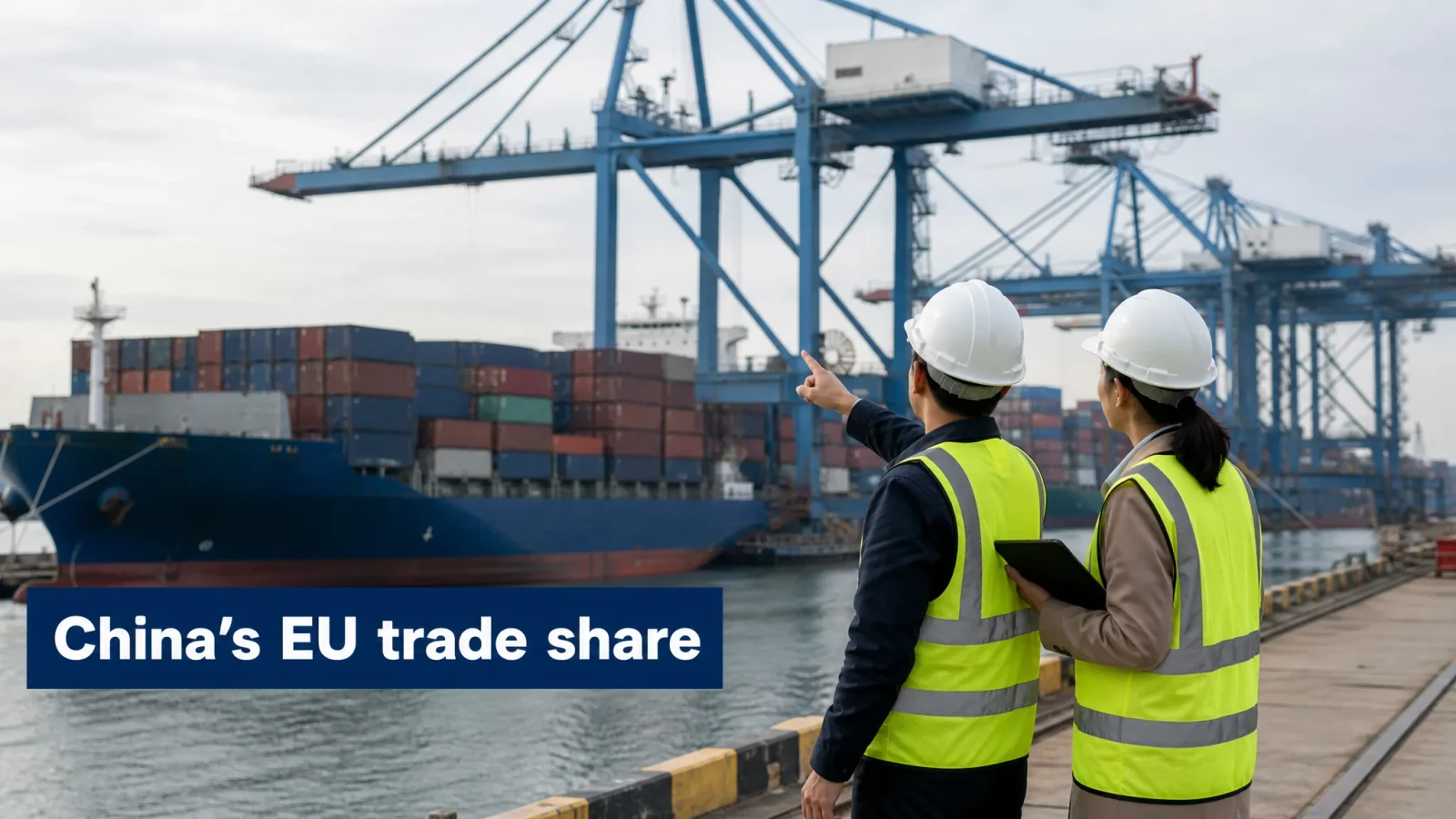
Eurostat reported on 26 August 2026 that China was the EU’s largest supplier in Q2, with €153.6 billion and a 21.9% share of all imports. EU imports from China were 7.9% higher year on year. For a business, this measures market scale and dependence—not the quality or resilience of one supplier relationship.
Measure dependence at SKU level
A 21.9% aggregate share does not tell you whether a critical component is replaceable. Tag products by technical interchangeability, tooling lock-in and lead time.
More trade means more competition
Rising imports can mean availability and supplier choice, but also greater demand for capacity, freight and inspection. Negotiate beyond unit price.
Resilience is a conscious cost
A second supplier, safety stock and alternate specification cost money. Compare that cost with contribution lost during a disruption.
Practical checklist
- Calculate the China share for critical SKUs, not only company turnover.
- Prepare technical approval for a second origin or supplier.
- Document tooling ownership, MOQs and transfer time.
- Set safety stock against replenishment, cashflow and shelf life.
Decision frame for your import
Eurostat reported on 26 August 2026 that the EU imported €701.8bn of non-EU goods in Q2 and that China was the largest supplier at €153.6bn, or 21.9%. Imports from China rose 7.9% year on year. The scale shows dependence and infrastructure, not suitability of your individual supplier.
Data and document pack per item
Measure China dependence at SKU and component level: revenue, contribution, interchangeability, tooling ownership, lead time, MOQ, qualification time and alternate origin. Add plant, sub-suppliers, payment terms, stock and transfer plan. The EU total is context, not a risk file substitute.
- Prioritise critical SKUs by failure cost and replacement time.
- Prepare technically approved alternate plants or origins.
- Secure tooling and data ownership contractually.
- Balance safety stock against cash, shelf life and lead time.
A verification workflow from supplier to import
- Calculate China share and single-source exposure by critical SKU.
- Qualify a second supplier or origin for top risks.
- Approve pilot sample, inspection plan and capacity before an emergency.
- Document transfer time, tooling movement and regulatory reapproval.
- Update the risk review with Eurostat context, actual performance and stock cover.
A worked decision example
A company imports 90% of a critical component from China, although the aggregate statistic is only context. A second origin costs 4% more but needs six months qualification. The importer starts a pilot now and holds limited stock. The premium is smaller than the cost of a production stop during a disruption.
Common failure modes and countermeasures
- Reading 21.9% as quality or price proof — separate market scale and supplier diligence.
- Keeping dual sourcing on paper — test sample, tooling and capacity.
- Ignoring approval time for an alternate origin — plan regulatory qualification.
- Increasing stock without cash and shelf-life review — model scenarios.
Message to send to the Chinese supplier
Ask incumbent and new suppliers about resilience, not only price:
Please state plant, critical sub-suppliers, spare capacity and tooling ownership for our SKU. Please report material, process or export changes and realistic transfer time to a second plant. Please confirm which technical documents must be repeated after a plant or origin change.
Release criteria for the file
A release is defensible only when four questions can be answered from the same record: What exactly was checked? Which SKU, batch, route or period does the statement cover? Which primary source or supplier document supports it? Who assessed the deviation and when is it reviewed again? Put those answers in the inspection report instead of marking a line only “passed”. Link the file to the order, sample and receipt. If evidence is missing, give the line an “open” status with an owner and due date. This keeps later corrections traceable and lets procurement distinguish evidence from assumptions.
Follow-up and recheck
Approval is not the end of the check. Set a trigger for the next review: a new batch, material or process change, an authority notice, a price or lead-time deviation, or the scheduled review date. A short monthly reconciliation of orders, supplier data and received goods catches drift earlier than an annual catch-up. When a deviation appears, hold the affected batch, obtain a written supplier response and reopen approval only after a documented corrective record.
<!-- Release template: research review 2026-09 -->Internal release template
A check mark saying “reviewed” is not enough for this topic. In one short line, state that prioritise critical SKUs by failure cost and replacement time.. Add the exact scope (SKU, batch, plant, shipment or period), the primary source and document version. The second line records the open assumption or deviation, its owner and due date. The third line records the release decision and which shipment or version remains on hold. Another colleague should be able to reproduce the decision without searching an entire email thread.
Conclusion
Eurostat confirms China’s central role, but it does not replace risk analysis. Use the scale of the market while building a realistic fallback.
Frequently asked questions
Does a 21.9% EU import share mean China is always cheapest?
No. It describes trade volume, not your price or total risk-adjusted cost.
How quickly should I dual-source?
Start with SKUs that have long qualification or high failure cost and approve alternatives in stages.
Does high EU–China trade prove a safe supply chain?
No. It shows scale and infrastructure. Safety depends on technical interchangeability, stock cover and supplier redundancy.
How can a small business start dual sourcing?
Start with SKUs whose failure cost is high, qualify a small pilot and stage tooling and transfer costs.
Sources
Reading aid
Glossary terms in this article
These terms occur in the article. Hover over a highlighted term or open its entry for the full explanation.
- Dual sourcing
- Dual sourcing allocates a critical item to at least two qualified supply sources.
- Lead time
- Lead time is the period from placing an order to the agreed receipt of goods.
- MOQ
- MOQ (Minimum Order Quantity) is the smallest order quantity a supplier accepts.
Editorial source review: Eurostat Q2 2026 values were translated into an SKU risk and dual-sourcing matrix; they are not a quality judgement on individual Chinese suppliers.
FAQ
Does a 21.9% EU import share mean China is always cheapest?
No. It describes trade volume, not your price or total risk-adjusted cost.
How quickly should I dual-source?
Start with SKUs that have long qualification or high failure cost and approve alternatives in stages.
Does high EU–China trade prove a safe supply chain?
No. It shows scale and infrastructure. Safety depends on technical interchangeability, stock cover and supplier redundancy.
How can a small business start dual sourcing?
Start with SKUs whose failure cost is high, qualify a small pilot and stage tooling and transfer costs.
Read more
Certified e-commerce merchant (IHK), lives in Guangzhou, inspects Chinese suppliers in person.
About the author →